

While a ‘standard’ low FODMAP diet works well to improve symptoms of irritable bowel syndrome in most patients, this diet has its drawbacks and is not suitable for every patient.
Potential drawbacks of the standard FODMAP diet:
For these reasons, some patients might be better suited to non-dietary interventions for IBS management. Examples of non-dietary interventions for IBS include:
Other patients might be better suited to a different type of dietary intervention to manage their IBS symptoms. Examples of other, evidence-based dietary interventions for IBS include:
Sometimes known as a simplified FODMAP diet, or FODMAP-light approach, the FODMAP gentle diet is simply an adaptation of the standard FODMAP diet. Essentially, it is a less restrictive approach to the Step 1 FODMAP diet. On a FODMAP gentle diet, you would:
| Standard low FODMAP diet | FODMAP gentle diet |
|---|---|
| All foods high and moderate in FODMAPs in a single serve |
Foods very high in FODMAPs and are frequently consumed OR Foods high in fructans and/or GOS |
A small number of studies have evaluated the efficacy of the FODMAP gentle diet. For example, a recent double-blind, pilot randomised control trial involving 35 adults with IBS-D compared the efficacy and tolerability of a FODMAP gentle diet versus a standard FODMAP diet. The FODMAP gentle diet involved only restricting foods high in fructans and GOS for 4 weeks. The study showed that a similar proportion of patients responded to the two diets: 63% (10/16) responded to the FODMAP gentle diet versus 56% (9/16) responded to the standard low FODMAP diet. Interestingly, there were fewer dropouts on the FODMAP gentle diet (13% vs 26%), although stool consistency outcomes favoured the standard low FODMAP diet, which the authors attributed to the broader FODMAP restriction. The authors concluded that a FODMAP gentle approach is practical to implement, tolerated by patients and effective in improving GI symptoms in most patients with IBS-D. Of course, as a small pilot study, larger placebo/sham diet-controlled studies are needed to confirm these findings.
Similarly, a study conducted in 459 patients with IBS recruited from primary care found that participants randomised to receive smartphone-based FODMAP diet education (FODMAP gentle diet) were more likely to experience an improvement in IBS symptoms compared to participants randomised to receive an antispasmodic drug (otilonium bromide). In this study, 71% responded to the FODMAP gentle diet compared to 61% that responded to the medication{Carbone, 2022 #3299}
Finally, studies that have assessed the efficacy of the BDA/NICE guidelines diet give some indication of the effect of a FODMAP gentle diet. The BDA/NICE guidelines diet encourages a regular meal pattern; the avoidance of excessively large meals; a reduction in excessive intake of fat, fibre and caffeine, a reduced intake of gas-producing foods, such as onions, beans and cabbage, and the avoidance of particular FODMAPs such as lactose, sorbitol, and other polyols used as low-joule sweeteners. This advice would incidentally reduce intake of many FODMAP-rich foods, and mirrors the advice of a FODMAP-gentle diet. For instance, a recent meta-analysis that included 8 trials found that BDA/NICE diet was more effective than habitual diet for the relief of overall IBS symptoms.
A FODMAP Gentle approach might be suitable for the following patients:
Advantages of a FODMAP gentle approach
Disadvantages of a FODMAP gentle approach
The following table lists very concentrated sources of FODMAPs that would be restricted on a FODMAP gentle diet. Patients who achieve a good level of symptom control using a FODMAP gentle approach in Step 1 can use a ‘simplified’ challenge approach in Step 2 whereby they would only challenge foods and FODMAPs that were restricted in Step 1.
For example:
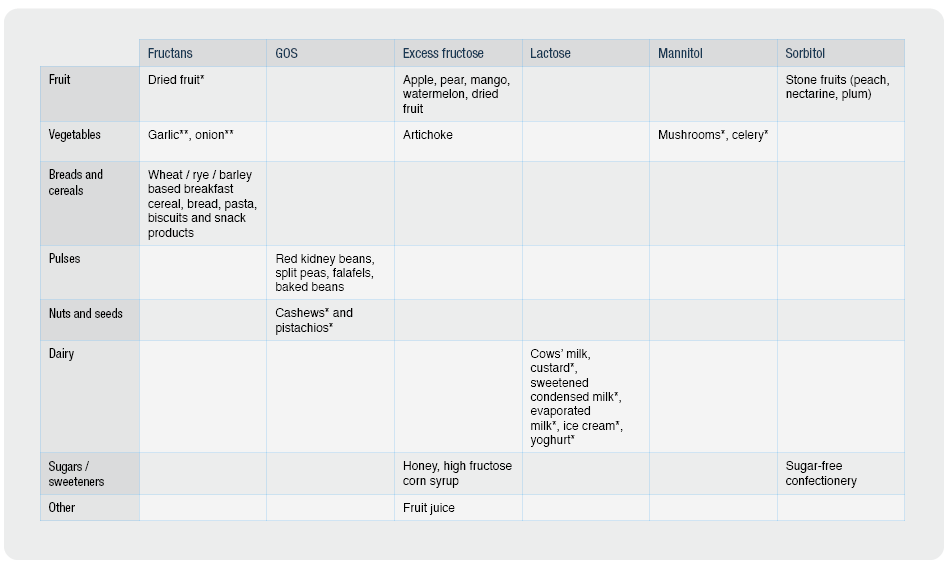
* Only remove these foods in certain patients. For example, a patient who eats mushrooms frequently may be encouraged to avoid mushrooms initially. By contrast, a patient who eats mushrooms only occasionally and in small quantities, may be advised to continue consuming these foods.
**Exclude garlic and onion if they are major ingredients, but include if they are minor ingredients in processed foods (e.g. garlic/onion added as a flavouring agent in marinades, sauces & vegetarian mince)
In summary, the standard low FODMAP diet is highly effective for many people with IBS, but it is not the best diet for everyone. The FODMAP gentle diet is a less restrictive approach that only limits the highest FODMAP foods or only restricts foods high in specific FODMAPs such as fructans and GOS, making it easier to follow and less likely to cause problems. Emerging evidence shows that this less restrictive low FODMAP diet can provide symptom relief comparable to the standard FODMAP diet. While there is less evidence supporting the efficacy of a FODMAP gentle diet compared to a standard approach, it may be a good, simple option for people with mild symptoms, children, older adults, those with limited dietary skills, or people already managing other dietary restrictions.